 Translate

AI Summary
- Striking off a company under the Companies Act, 2013 is a cost-effective mechanism for corporate exit, removing inactive companies from the Register of Companies (ROC).
- Companies become inactive due to financial, strategic, operational, or legal reasons, making legal compliance difficult and prompting the need for removal from ROC records.
- Striking off can occur two ways: by the Registrar of Companies (ROC) for non-compliance, or through a Suo Moto application by the company itself.
- Companies cannot apply for striking off if they changed name, disposed property, or failed to file overdue financial statements within the previous three months.
- Listed companies, vanishing companies, and firms with pending prosecutions or outstanding public deposits are ineligible for striking off from ROC.
In a dynamic Business environment, Many Companies become inactive due to financial, Strategic, operational and Legal Reason. Once any Company become inactive it is difficult to comply with the legal requirements under the Companies Act, 2013. The Concept of Striking off the business introduced under Companies Act, 2013 is one of the most Cost effective mechanism for Corporate Exit under Indian Company Law, This process help companies which are inactive could be easily removed from the Register maintained by Registrar of Companies (ROC).
What Does Striking off the Company Mean?
Striking off the Company is a legal mechanism to remove the name of the Company from the Register maintained by the Registrar of Companies, bringing the existence of the Company to end.
This method is mainly applicable on Companies which are inactive or no longer carrying its operations.
Modes of Striking off the Company: Step-by-Step Methods
Striking off can be handled in two ways
By Registrar of Companies
ROC may remove the name of the Company due to following reasons
- The Company has failed to commence its business within one year of Incorporation
- The Company is not carrying any business for a period of 2 preceding financial year and failed to obtain a Dormant Status.
- The Subscriber to the memorandum has not paid the Subscription Money and Company has not filed declaration (Form INC – 20 A) to this effect within 180 days from the date of Incorporation
- The Company is not carrying any business after physical verification.
ROC shall send a notice to the Company and all the Director of the Company about his intention to remove the name of the Company from the Registrar of Company and will ask them to send their representation with necessary documentation.
Suo Moto Application
Company can Suo moto apply for the Striking off the Company if
- The Company has become inactive
- The Company has extinguished all its liabilities
- The Company is no longer running its business
Restriction on making application in Certain Situation
A company cannot make an application to the Registrar of Companies (ROC) if, within the previous 3 months, it has been involved in any of the following:
- The Company has changed its name or registered office from one state to another.
- The Company has made a disposal for value of property or rights held by it, immediately before cesser of trade or otherwise carrying on of business, for the purpose of disposal for gain in the normal course of trading or otherwise carrying on of business.
- The Company is engaged in other activity except the one necessary or expedient for the purpose of making application under that Section.
- The Company has made application to tribunal for compromise or arrangement.
- The Company has not filed overdue financial statements under section 137 and overdue annual returns under section 92, up to the end of the financial year in which the company ceased to carry its business operations
Why Some Companies Cannot Be Removed from ROC Through Striking Off
The following categories of Company cannot be removed from the Registrar of Companies are:
- Listed Company
- Vanishing Company
- Companies that have been delisted due to non-compliance of listing regulations or listing agreements or any other statutory laws.
- Companies whose notices under section 234 of the Companies Act 1956 or section 206 or section 207 of the Act have been issued by the Registrar or inspector and reply thereto is pending or report under section 208 has not yet been submitted or follow up of instructions on reports under section 208 is pending or where any prosecution arising out of such inquiry or scrutiny, if any, is pending with the court.
- Companies against which the prosecution is pending in any court.
- Company whose application for compounding is pending before the competent authority for compounding of offences committed by the Company and any of its officers in default.
- Companies, which have accepted public deposits which are either outstanding or the Company is in default in repayment of the Same.
- Companies having charges which are pending for satisfaction.
- companies registered under section 25 of the Companies Act, 1956 or section 8 of the Act.
- Companies where inspection or investigation is ordered and being carried out or actions on such order are yet to be taken up or were completed but prosecutions arising out of such inspection or investigation are pending in the Court;
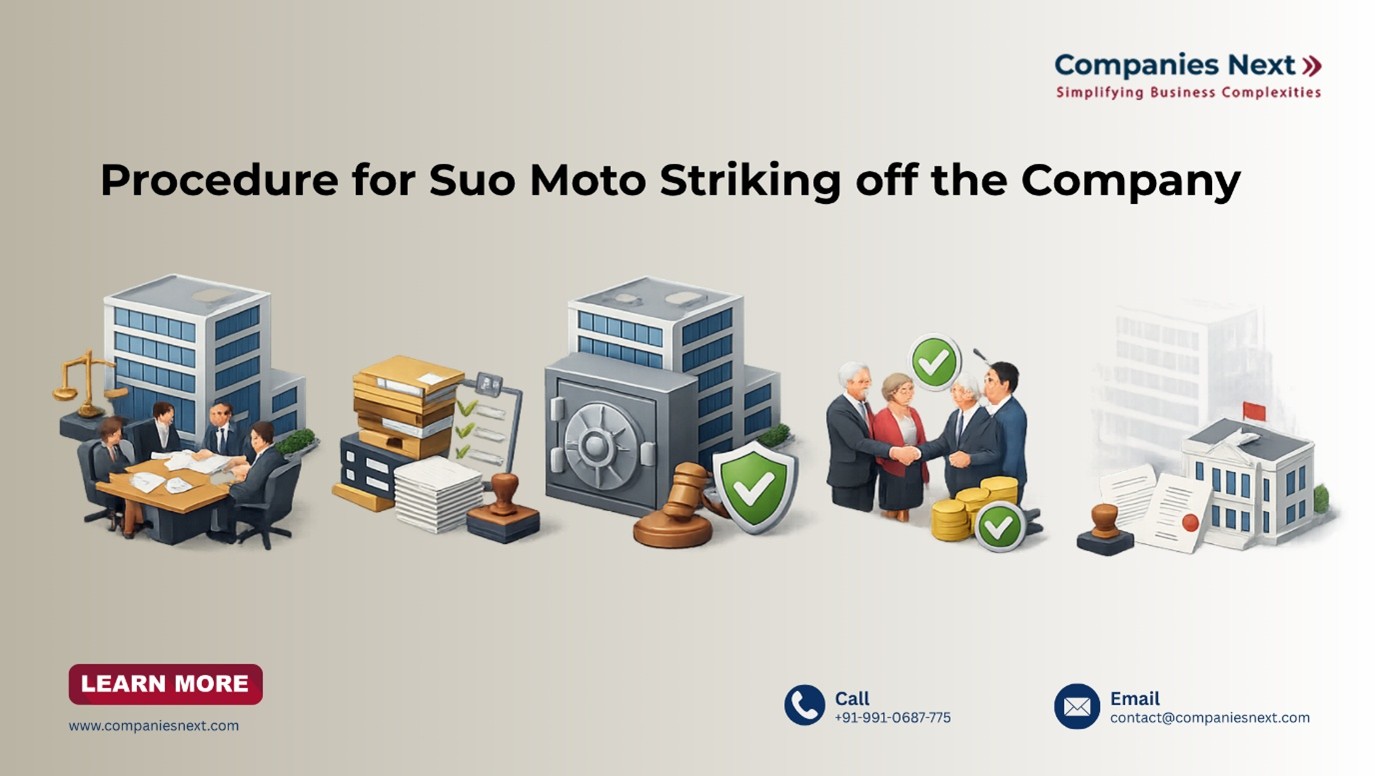
Procedure for Suo Moto Striking off the Company
Step 1 - Passing of Board Resolution
Company will pass a Board Resolution approving strike off the business of the Company and will authorize the Director/Company Secretary to file the application with Registrar of Companies.
Step 2 - Settlement of Liabilities
Company needs to settle all its liabilities and shall also receive approval from any regulatory body if governed under any Special Act which will be enclosed with the application.
Step 3 - Closing of Bank Accounts
Company needs to Close all bank accounts held in the company’s name and obtain Bank Account Closure Letter which will be enclosed with the Application.
Step 4 - Shareholder’s Approval
Obtain shareholders’ approval by passing a Special Resolution or securing consent from at least 75% of shareholders (in terms of paid-up share capital).
Step 5 - Filing of Application
Company will file Form STK – 2 with Registrar of Companies along with necessary documentation includes
1. Indemnity Bond (Form STK-3) duly notarized by all directors, confirming that the company has no assets and liabilities, as on date and undertaking to settle any future liabilities arising in future after the striking off the name of the Company;
2. Affidavit (Form STK-4) from directors confirming some specific declarations mentioned in the format provided by the Ministry and is eligible for strike-off;
3. Statements of Accounts (Form STK-8) certified by a Chartered Accountant, showing nil assets and liabilities and not older than 30 days from the date of filing;
4. Certified copy of the Special Resolution or consent of 75% shareholders along with the filing fees and other documents
5. A statement regarding pending litigations, if any, involving the company.
STEP 6 – ROC Examination and Public Notice
Registrar of Companies examine the application along with the attached documents to ensure application compliant with the Companies Act, 2013 and related rules & Regulations, ROC can further issue Public notice in Form STK – 6, which will be published on MCA Website and Official Gazette along with publishing notice on the English and at least once at Vernacular Newspaper and ROC can simultaneously intimate concerned Authorities having jurisdiction over the Company for any kind of objection to be received within 30 days from the date of issue of Intimation
STEP 7 – Finally Strike off
If No objection received within the prescribed timeline or if there is any objection raised which are resolved, ROC shall proceed with Striking off the Name of the Company from the Registrar of Companies and notice shall be issue on Official Gazette, hence the Company will be dissolved.
Documents Required for Striking off the Company
- Indemnity bond duly notarized by every director in Form STK 3
- Statement of accounts in Form STK – 8 containing assets and liabilities of the Company made up of the day, not more than thirty days before the date of application and certified by Chartered Accountant
- An affidavit in Form STK 4 by every director of the Company.
- A statement regarding pending litigation, if any involving the Company
- Board Resolution
- Consent of 75% of the Shareholder
- NOC from regulatory Authority
- MOA & AOA of the Company
- Latest Income Tax Return (ITR)
- Bank Account Closure Proof
- Details of the Shareholders
Conclusion
Striking off a company under the Companies Act, 2013 is a simple and cost-effective way to close inactive businesses. It provides an easy exit while ensuring compliance with legal requirements and protection of stakeholders. Through the strike-off process a company can avoid ongoing compliance responsibilities, save on unnecessary costs, and protect shareholder interests. Therefore, it shall be very important to review eligibility requirements and complete the necessary regulatory formalities to ensure compliance and a seamless closure process.
Why choose Companies Next?
Companies Next provides complete strike-off services including assistance with the requisite documentation and timely filing by experienced professionals. Our services are designed to reduce the likelihood of your company being rejected in terms of its strike-off application because we will ensure that all requirements set out by the Registrar of Companies (ROC) are complied with. We provide an all-inclusive pricing structure with no hidden fees or charges and committed support for all aspects of the strike-off process. As we have experience of completing strike-off applications, we can assist you in completing the company closure process quickly, efficiently and without stress.